
Reasons for food insecurity
Food Insecurity, Part 2 of 3
-
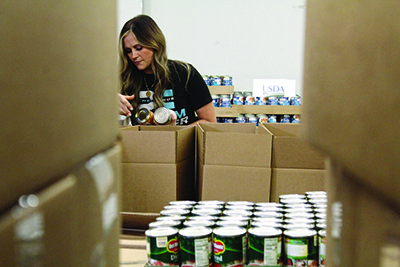
A Second Harvest volunteer boxes cans of food for needy families. - Photo Submitted
-
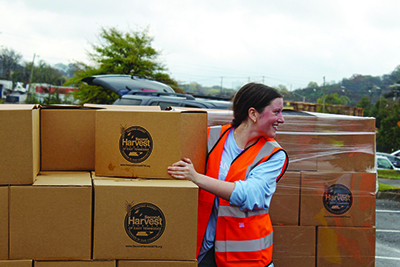
One of many volunteers receiving boxes of donated food. - Photo Submitted
Food insecurity continues to climb in East Tennessee.
By going to the food bank, “they’re trying to help supplement the food,” said Joan Cambeses, who is charge of the pantry at Grassy Valley Baptist Church. “You get used to a certain amount of income or a certain amount of food coming in once a month and suddenly it’s cut in half. Then (they think), ‘OK, what do I do?’
“Some of these people, I understand, have such large families and children, it’s very difficult,” she added.
“Notably, half of the food-insecure households earn too much to qualify for SNAP,” Second Harvest senior marketing and creative strategist Jon Rice said. “These are working families above the income cutoff who, nonetheless, cannot afford enough food at the grocery store due to rising inflation and lack of a living wage.”
Second Harvest hosted a holiday drive-through distribution
at Redemption Church, 3550 Pleasant Ridge Road, Wednesday, Nov. 19.
While Cambeses mostly spends time in the back, preparing foods for distribution, she has talked to a few recipients.
“Some of it is they are out of work or they’re going to be starting a new job or they have to wait until their next paycheck,” she said. “A lot is the SNAP program.
“They said it’s been cut, like, in half, and they just can’t make ends meet, especially ones with huge families,” she said.
“In practice, our pantries see working parents and individuals coming in and needing assistance,” Rice said. “They may miss a meal so their children can eat or they rely on our Food For Kids program to help get their families through the weekend or during holidays.
“For too many of our East
Tennessee neighbors, a steady paycheck no longer guarantees food when rent, utilities and healthcare costs have soared,” Rice added.
Along with many economic and social factors, families on the Supplemental Nutrition Assistance Program (SNAP, also known as food stamp) have to meet new regulations.
“During November, we had more new guests than normal and the underlying issue was SNAP benefits,” Stone said.
“Recent SNAP policy shifts are starting to create even more demand on food banks,” Rice said. “Nearly 700,000 Tennesseans rely on SNAP, including about 34,000 in Knox County alone. And proven by what we just witnessed during the shutdown, when federal or state benefits lapse thousands more turn to food banks.
“Meanwhile, new SNAP regulations will make it harder to get assistance,” he warned. “Under the recent federal law — often called the ‘One Big Beautiful Bill’ — work requirements were sharply expanded.
“The Congressional Budget Office estimates that around 2.4 million people will no longer qualify for SNAP on average each month because of the new provisions, and food banks all across the country are bracing for the impact,” he said. “For every meal provided by food banks, SNAP delivers nine. It’s the most effective tool we have to fight hunger.
“Food banks simply cannot replace SNAP at the same scale,” he said.
“The first 10 months of 2025, we averaged approximately 95 families a month, which is almost equal to average families served in 2024,” said Renee Stone, director of Shepherd of Hope Food Pantry, which is housed in Faith Lutheran Church in Farragut. “There is strong evidence that our numbers for November were affected by lack of SNAP funding, and we are preparing for the same in December.
“I am not sure what the federal government’s plans are for SNAP reform,” she said. “The only thing I know, at this point, from the federal government website regarding SNAP, is that states will have financial responsibility to partially fund SNAP — I think starting 2028.
“I have also read from the state of Tennessee and federal government websites that SNAP recipients who are working age with no dependents or disabilities will have work/volunteer/education requirements to continue receiving SNAP benefits,” Stone said. “I have no idea when these changes will be effective.
“Our immediate need now is continued community support through donations so we can continue to feed those who visit the pantry,” she said. “So far, we have been able to meet the need.”