
A memorable career
Former Farragut football coach leaves legacy
-

Former Farragut High School head football coach Dan Bland, pictured left, with his son John Bland, died Sunday, Dec. 21, at the age of 81 in Jackson, Tennessee. Several of his friends and former players took time to remember Bland’s impact as a coach and an individual. - Photos submitted
-
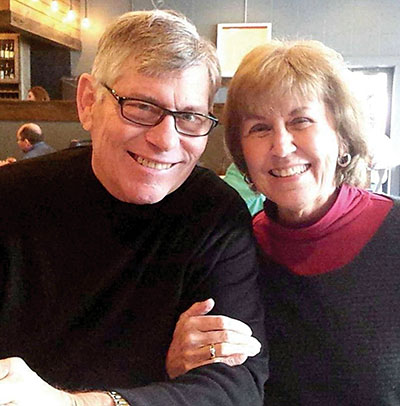
The late Dan Bland and his wife, Martha Bland. - Photos submitted
-
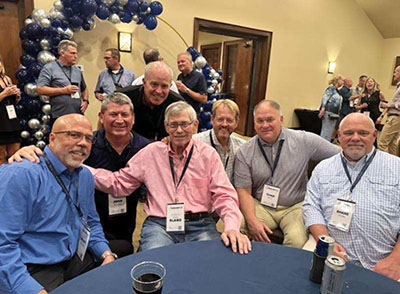
The late Dan Bland, a former Farragut head football coach, gathered with several former players from the 1985 class at a 40-year reunion in August 2025 at FHS. Pictured from left to right: Scott Simon, John Bland, Jed Dance, Dan Bland, Tom Pfeiffer, Chad Bell and Shane Penn. - Photos submitted
Roy Stone still can remember his first impression of Dan Bland.
It was the spring 1980 in Stone’s junior year at Farragut High School, and Bland had just been hired to replace former coach Ken Sparks. Sparks, of course, would go on to achieve historic success at the college level with Carson-Newman University.
But Coach Bland — in the midst of a memorable career himself — was just getting started in west Knoxville. One film session was all Bland needed to familiarize himself with his new team.
“I remember when he first pulled us all together in the auditorium,” recalled Stone, then a running back for the Admirals. “He said, ‘I’ve been looking at some film. And y’all are soft.’”
“That got our attention,” Stone added. “He came in and called it right out.”
Mr. Bland swiftly changed that approach at Farragut, guiding the Admirals to a 53-24 record with two district titles and the first state semifinal appearance in school history. That seven-year stretch was just one stop in his memorable career, which spanned multiple states through four decades with a final record of 175-112.
Bland’s career — and life as a whole — have been remembered with fondness after his death at age 81 on Dec. 21 at his home in Jackson, Tennessee. In the days since Bland’s death, farragutpress has spoken with a few of his relatives, friends and former players. Together, those different accounts have woven a tapestry befitting a former FHS skipper whose legacy extends far beyond the numerous fields on which he coached.
Rooted in physicality
Before leading Farragut or any other program, Bland experienced plenty of success as a player.
A native of Covington, Tennessee, he carved out a memorable college career as a halfback at Mississippi State. There, under the tutelage of an assistant coach named Johnny Majors, Bland grew into a sizable halfback who wreaked havoc across the SEC. He led the nation in kickoff return yardage with 558 in 1964, a record that stood for more than 40 years. That same year, he helped the Bulldogs — then called the “Maroons,” according to the New York Times — beat Ole Miss for the first time since 1946. In 1965, Bland served as a team captain and helped the Bulldogs upset Heisman Trophy favorite Steve Spurrier in Gainesville.
One year later, he was drafted by the Houston Oilers of the American Football League and the San Francisco 49ers of the NFL. Bland opted for San Francisco, then suited up for the Pittsburgh Steelers and, later, the Houston Oilers to bring his pro career to a close in 1968.
Throughout his time in college and the NFL, Bland used a physical running style that played into his own philosophy as a coach.
“You need to have physicality to win consistently, and he knew that,” said Bland’s son, Farragut alum John Bland. “I think that’s why he was such a good coach, too.”
Years later, Stone benefitted from that approach when the elder Bland took over the Admirals. Bland switched FHS from Sparks’ Veer option to a Power I formation, offering specific instruction for how to run the ball.
“We loved when he put that in because it meant we got to run a lot,” Stone said with a chuckle. “And (Bland) taught his top running backs how to finish, too. I remember one time we were getting ready to scrimmage a team, and he told us, ‘If you break into the open field, instead of just going for a touchdown, you find a defensive back, and you go punish him.’”
Coach Bland’s physical approach went far beyond the field, too, as former Tennessee long snapper Joel Farmer noted from his own time with Farragut.
“We would wrestle and box during the offseason, which really helped,” Farmer said. “It’s a tough world out there, and people want the more comfortable path. Then when they get slapped in the head by something in life, they’re not ready for it.
“I see now what Coach Bland was trying to do — not just getting us ready to play Oak Ridge or whoever else, but getting us ready to face adversity in our lives. That stays with you.”
Bland’s words clearly resonated with Farmer, who later followed his coach’s advice by trying out to become the Vols’ long snapper. He wound up earning a scholarship and played under Majors in the famed 1986 Sugar Bowl win over Miami.
“That was a God thing,” Farmer said. “It changed my life.”
In the more immediate future, coach Bland’s words helped the Admirals improve from 7-4 in 1980 to 11-2 in 1981. That year, Farragut caught fire to capture the Class AAA District 3 championship and reach the state semifinals.
Among an 11-2 record, one win stood out: a 35-7 drubbing of Oak Ridge to snap the Wildcats’ 29-game win streak. In a game that the Admirals desperately wanted, one Bland decided to pour a bit more salt into the wound.
Bland’s elder son, late Farragut quarterback Mike Bland, walked up to the line of scrimmage and offered a warning to the Oak Ridge players.
“We’re going to run it right there,” he said, extending his finger to point to the exact spot. “And you can’t stop it.”
That confidence, while loud in others, was quietly present in Bland’s coaching style. He passed that same approach on to his son John, now a coach for Little Rock Catholic.
But it also seeped into two other coaches who found success after working with Bland. And when they faced off against each other, Joe Gaddis and Eddie Courtney both used lessons they learned from him.
‘A near perfect man’
Gaddis was the first of the two coaches to encounter Bland, as they connected in 1968.
At the time, Gaddis was a junior defensive back at West Tennessee’s Jackson High School, which later turned into Jackson Central-Merry (JCM).
“He moved in and became my position coach,” Gaddis reflected of Bland. “Like most guys, I took to him immediately. He was so enthusiastic, positive and just magnetic.
“He’s the reason I became a football coach. I wanted to be like him. He is the reason I am who I am today.”
They forged a relationship beyond a typical player-coach bond, which began when Bland hired Gaddis to join him at Tullahoma High School in 1976.
“We became like brothers over half a century,” Gaddis said. “Whether we saw each other all the time or not, we talked probably every month or two for 57 years. He was my best friend of a lifetime.”
From Tullahoma, Bland and Gaddis went to Farragut in 1980. There, Courtney joined the staff after working under Sparks to form the second limb of Bland’s remarkable coaching tree.
“He believed in having great people to surrounding him with, and he let you coach,” Courtney said. “He gave you responsibility and expected you to fulfill that.”
“And he made coming to work fun,” Gaddis added. “He kept things light on the staff, something I tried to continue in my own career. He was the best storyteller I’ve ever known, too.”
After branching off from Bland, Courtney and Gaddis wound up finding success on their own, too.
At FHS, Courtney led the Admirals to a 204-121 record, including the program’s first state title in 2016. He also battled through cancer and displayed the same kind of toughness he wanted his players to show on the field.
At Oak Ridge, Gaddis went 196-58 over two separate stints to become the winningest coach in program history. He wound up with more than 300 wins through multiple stops as a head coach.
He and Courtney faced off several times in an intense Farragut-Oak Ridge rivalry, forming their own friendship that transcended whatever happened on the field.
In short, each coach reached his pinnacle, just as Bland did.
But both coaches saw Bland traverse plenty of personal valleys, too — none bigger than the death of his son Mike in a 1986 car accident.
“He dealt with adversity on the field and in life better than anyone I had seen,” Gaddis recalled. “That was obviously a tough, tough time. He handled that better than anyone thought was possible.
“I learned so much from him about football and how to deal with people and how to be a positive force. He was a special guy. In addition to being a great coach and mentor, he was even better as a father and a person. A near perfect man.”
While Bland handled the situation in an admirable way, his surroundings at Farragut became too tough to stomach in the grief that followed.
“We really loved our time there and probably would have stayed longer,” John Bland said. “But when Mike’s car wreck happened, Dad really needed a change of scenery.”
Bland ultimately coached at a few other programs across the Southeast, most in west Tennessee with one stop in Pascagoula, Mississippi. In his final year at Humboldt, his last as a head coach, he met a familiar foe twice to bring his career full-circle.
“When I was at Peabody in Trenton in 2012, Coach Bland was at Humboldt,” Gaddis recalled. “We played them during the regular season and again in the playoffs.”
Gaddis and Peabody won both games, besting his lifelong friend two separate times. One of those victories even snapped a 17-game win streak Bland had accumulated with the Vikings. But for Gaddis, neither that win nor the other one against his mentor proved half as sweet as the games they coached together.
“We’re both fierce competitors, and I wanted to win. But I did not want (Bland) to lose either,” Gaddis explained. “I did not enjoy that at all. The build-up was kind of fun, but that was a very bittersweet time.”
Ultimately, Bland was fired from his final post at Humboldt in a move that Bland himself called “stunning,” according to a 2012 Northwest Tennessee Today article. His description was accurate, as Bland had just been named District Coach of the Year.
He went on to serve as an assistant at Peabody under Ricky Woods — who replaced Gaddis — and they promptly handed Bland’s former team a 21-20 loss in 2013. Later, Bland even returned to Humboldt to assist the man who had taken over his former post before ultimately calling it a career.
Throughout all of that, one moment stood out to those who knew Bland best. Less than a day after he had been removed at Humboldt, two of his assistant coaches resigned in a show of support for their leader.
“That’s the kind of support he had,” said John Bland. “It was amazing.”
A fulfilling legacy
That move spoke to Bland’s invaluable impact, and no one felt that more than his children. The longest-reaching piece of his father’s coaching tree, John Bland played for his dad at Farragut before continuing his football career at Arkansas under Ken Hatfield.
“People would ask me how it was to play for my dad,” he said with a smile. “He would be even harder on me because he knew he could be, but I didn’t think of it that way. I got the best of both worlds, having him as a coach in practice but getting a little more at the house, too. So I had an advantage and a blessing in being his player and his son.”
That blessing flowed into John’s own coaching career, as he worked as a graduate assistant under Pat Dye at Auburn. Like his dad, John Bland worked at multiple institutions before landing at Catholic in Little Rock.
Given his output at FHS, John was named to the Farragut High School Hall of Fame in 2019. His dad was no stranger to such honors, having been named to the Halls of Fame in Madison County and at Covington High. But the Farragut one specifically was special.
“I felt like I was representing him and my brother,” John Bland said. “It was really all three of us with the Bland name being recognized in a lot of good ways. He really made an impact there.”
That impact resonated this past August, as father and son returned to Farragut for a memorable reunion with hordes of former Admirals.
“When he got there, we barely got him to sit down because so many people stopped him to talk,” John said. “He held court at that reunion, and it showed how much he loved his players and treated them right.”
Forty-five years after that first meeting at FHS, Bland once again found a way to shock his Admirals. Except this time, instead of telling them how soft they were, he regaled them with stories of everything they accomplished together.
“He was every bit as intense as he ever was,” Farmer said. “He was telling stories, and everybody sat around like kids with their mouths open listening. He still had that influence.“
“We had some good times and some good players,” John added. “He sure loved it, and the kids loved him, too.”