Mayor reflects
Williams discusses decade of change
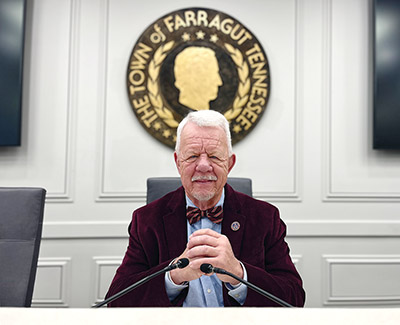
“My job was to roll up my sleeves and get to work on fixing everything that needed to be fixed,” Williams said of his time in office.
As he approaches the end of his term in August 2026, the mayor said there still are projects he hopes to see completed.
“There’s things I’d like to see done before I’m gone,” he said. “But everything has to go through the public discussion.”
Williams was first elected in 2016 as an alderman, then two years later, he was elected mayor in 2018. His first task was the corner of Kingston Pike and Campbell Station Road.
“There’s been a lot done in the past 10 years,” Williams said, reflecting on what the town looked like when he first took office.
He credited former Vice Mayor Louise Povlin, now a Farragut Municipal Planning Commission member, with focusing on ordinances and zoning reforms while he concentrated on roads and building improvements.
“I worked on the building portion of it and the roads,” Williams said. “When we were first elected, we had 16 substandard roads. Now, what we have left is four, and two of those have been partially done; one of them is under way and another has a grant to fix it.”
He said once work on Union Road, Virtue Road, Boyd Station Road and Boring Road is completed, only one substandard roadway will remain fully within town limits — Alan Kirby Road.
“[Alan Kirby Road] will be worked on when they do the next portion of the Bridgemore subdivision,” Williams said.
Part of Dixon Road also lies within town boundaries.
Currently, the town plans to use eminent domain to obtain slope easements needed to improve Union Road.
“We’re not trying to take anybody’s property,” Williams said. “We just need a slope easement to fix Union Road, and there’s a grant for that.”
He noted the project has been in progress for nearly eight years.
“Any time you’re dealing with the [Tennessee Department of Transportation and grants, you can’t get in a hurry,” Williams said.
Virtue Road is expected to follow.
“It’s coming up right behind Union,” he said.
Williams said work along Boyd Station Road tied to the Saddlebrook development is complete, though it has not yet passed inspection.
Another major project completed during his tenure was the Advanced Traffic Management System, which upgraded and interconnected traffic signals throughout the town in 2025.
Williams also reflected on how Farragut’s commercial corridors have changed.
“If I went to the corner of Kingston Pike and Campbell Station Road, what I saw was an abandoned gas station on one corner,” he said. “On the other corner was a Ruby Tuesday’s and Silver Spoon where the roof had caved in. It was abandoned.”
That area is now home to new restaurants and retail, including a Starbucks center, while the former gas station site is now occupied by 35 North.
Nearby, the historic Russell-Avery house — now the Campbell Station Inn — had been deteriorating, he said.
“That’s what the center of our town looked like,” Williams said.
“Back behind the bank on Concord Road, on the Biddle property, you had a burnt-down barn,” he said. “If you went on up Kingston Pike, on the opposite side of the road, back behind Century 21, you had an old millworks … the roof had caved in on that,
and if you walked inside of it, there was a water line about 4 feet up along the wall where it flooded … They just never went back in and fixed it. In the meantime, the roof caved in on it.”
This past year, a property owner filled in the area and now a tire store and oil change business is being built in that location, the mayor noted.
“Before [the owner] filled it in, it was probably about 10 feet lower,” Williams said.
Along Kingston Pike, the West End Center was renovated and reached full occupancy, and a former BP station site became a Tire Discounters. The old U.S. Golf property on North Campbell Station Road was redeveloped into a storage facility.
“Now, if you went the other direction, … you saw an old Ingle’s that had a Dollar Store in it,” he recalled. “If you walked in the Dollar Store, they had nine buckets sitting around on the floor because the roof was leaking in nine different places. Then, the rest of [the old part of the shopping center] was abandoned.
“So, what we had there was we had 13 empty buildings,” Williams said. Additionally, “We had three burned-down houses, two of them in Fox Den and one down on Virtue Road. We had a burned-down barn on Concord Road. We had an old Kroger’s that was abandoned … the kids were spray painting cuss words on it. Then you had the old Ingle’s that was falling down within itself.
Today, he said, those properties have largely been cleared or redeveloped. The old Kroger site was demolished and replaced with Town Center apartments and additional townhomes under construction. Two of the burned homes in Fox Den have been rebuilt, though the Virtue Road property remains vacant.
During that time, the town also purchased and restored the Russell-Avery house, converting it into the Campbell Station Inn and a visitor center, and built Mayor Ralph McGill Plaza around it.
“All those abandoned buildings and burned-down structures are gone,” Williams said.
Williams also pointed to changes at Dixie Lee Junction, where the former Court Café and remnants of the Court Motor Lodge once stood.
“In the past eight years, those buildings were torn down,” he said, making way for apartments and new retail space.
“They’re fixing to start on Starbucks and a strip mall,” he added. “It’s going to have two restaurants.”
Across the street, additional redevelopment replaced burned or abandoned homes with new construction, including an urgent care center, Dogtopia and The Church of Jesus Christ of Latter-day Saints Temple, which is under construction.
Before moving to Sugarwood subdivision in Farragut, Williams grew up in Powell but his uncle lived on Black Road.
“As a young person, I rode motorcycles all over what was then Concord,” Williams recalled. “It wasn’t Farragut yet. It was in the ’60s and ’70s.”
He first moved to Farragut in 1975 then in 1980, he moved to California for a contract to run a manufacturing plant. But he returned to Farragut in 1991.
Beyond private redevelopment, he cited town investments such as renovating the former Faith Lutheran Church building into a community center shared with the Knox County Senior Center, as well as improvements along Outlet Drive, where the former Outlet Mall was renovated and new developments reached full occupancy.