
Restrictions finally lifted
TDEC releases FUD from spill-related monitoring, warnings
-
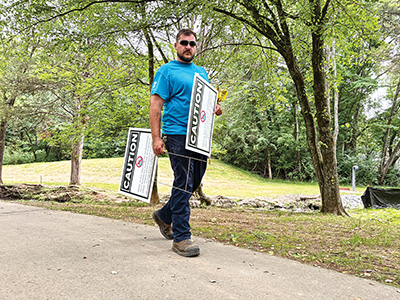
Farragut Parks & Recreation maintenance employee Josh Binkley removes warning signs and caution tape from Founders Park Friday afternoon, May 29, after Tennessee Department of Environment and Conservation gave First Utility District the green light to cease testing Turkey Creek and remove the signs. - Tony Cox
-
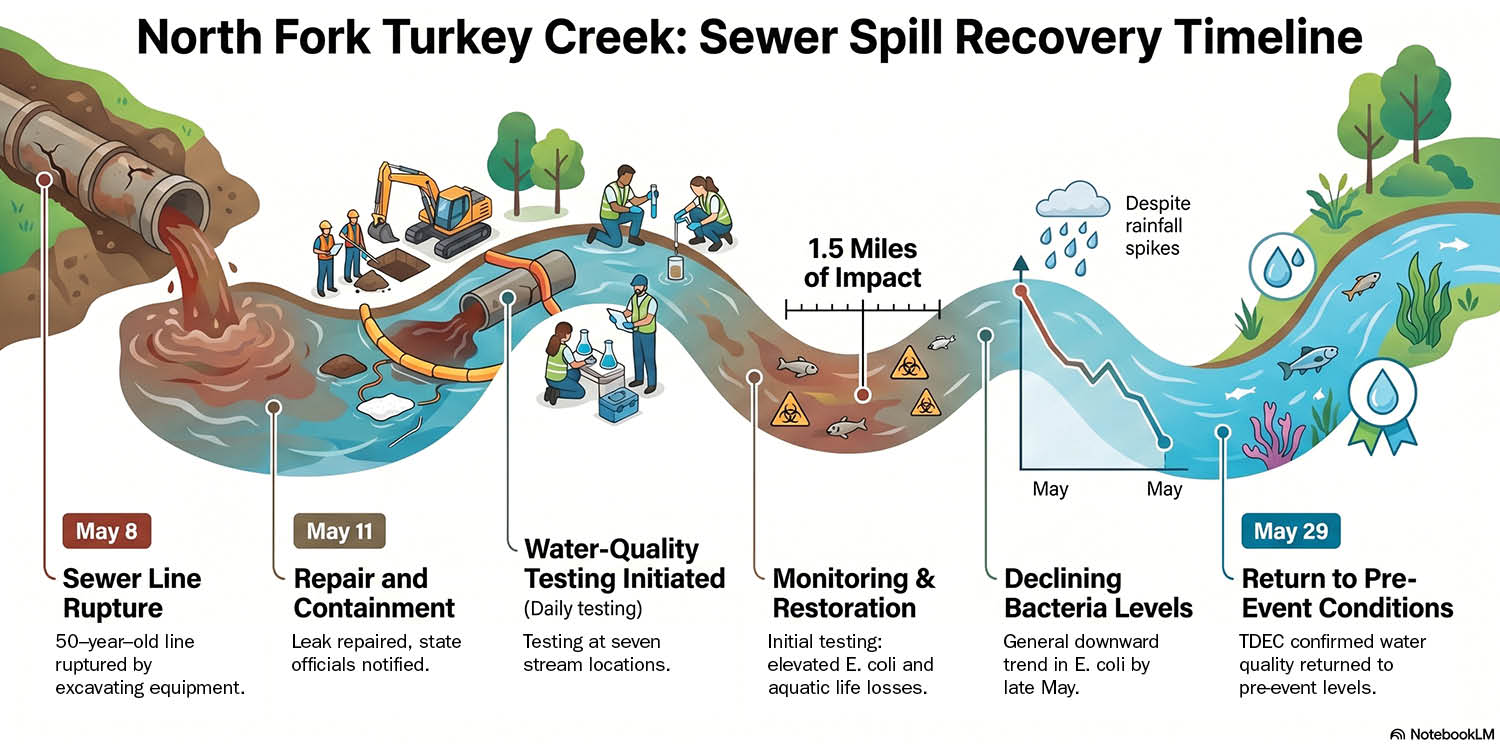
First Utility District was released Friday, May 29, from its obligation to sample water and post caution signs and tape to prevent access to Turkey Creek.
“I can confirm that the Tennessee Department of Environment and Conservation, on May 29, released First Utility District from posting signs and tape preventing public access to Turkey Creek around the area of the sewer line leak first reported on May 11,” said Jennifer Donnals, TDEC senior communications adviser.
“Samples for E. coli downstream of the event have returned to levels below the results from the reference site upstream,” she said Friday. “The utility says it will continue to sample at the normal locations as part of its operating program.”
Likewise, “current testing indicates that the affected area has returned to pre-event conditions,” FUD Human Resources manager Leea T. Butler said Friday afternoon.
“Based upon TDEC guidance and sampling review, overflow-related sampling and cautionary monitoring efforts conducted by FUD are now complete. FUD has published this update, along with final sampling data, on our website and Facebook page.
“We have also shared this information with the Town of Farragut,” Butler said, referring the public to FUD’s published updates for consistent information.
“First Utility District has been monitoring seven locations along North Fork Turkey Creek since
the sewer overflow on May 11,” Farragut Mayor Ron Williams said. “With bacteria samples returning to normal readings for that portion of the creek, TDEC has released FUD from any further monitoring of the creek.
“Our staff will begin taking down the signage and caution tape in Founders Park this afternoon.”
Asked whether Turkey Creek is safe for recreational use, FUD general manager Bruce Giles said the water samples are the same as they were before the spill and “it’s the individual’s choice to get in the water.”
Giles also sought to reassure residents about the safety of the drinking water supply.
“Those water sources are totally separate,” he said.
Butler explained FUD’s drinking water source is Fort Loudoun Lake on the Tennessee River.
“Our Water Treatment Plant is a 34-million-gallon-per-day conventional water treatment facility that provides safe drinking water to approximately 100,000 customers throughout the district,” she said. “The treatment process includes five primary steps: coagulation, flocculation, sedimentation, filtration and disinfection.
“These processes are designed to ensure that water supplied to our customers meets all applicable state and federal drinking water standards.
“Now that the event has been resolved, we would also like to emphasize First Utility District’s longstanding commitment to transparency, communication and providing quality water and reliable sewer service to our community,” Butler said.
“FUD regularly shares updates, news and general utility information through our social media platforms and website, where additional utility-related information and resources are available.”
Meanwhile, neighboring West Knox Utility District general manager Jim Reese said if his district has a spill that reaches a creek or other waterway, “we take two samples: upstream — before the spill — and at the same time, downstream of the leak.
“Upstream is the control number for what the creek
is naturally,” Reese said.
“We compare it to the downstream numbers.”
The utility continues sampling until the downstream numbers match the upstream readings and return to normal levels, he said.
Likewise, Lenoir City Utilities Board follows the same testing protocol as First Utility District because all Tennessee utilities are governed by TDEC, LCUB general manager Leon Shields said.
“It’s the Tennessee Department of Environment and Conservation protocol,” he said. “All public utilities, like ourselves, Loudon Utilities, West Knox Utility District and First Utility, have the same protocols. The state regulates us on all of that.”
Shields said LCUB’s service area was not affected by the Turkey Creek spill.
“We don’t take water out of the river above Fort Loudoun Dam,” he said. “Our water intakes are below Fort Loudoun Dam, so we’re considerably downstream. Our intakes are nowhere close to Turkey Creek.”