From Farragut to FIFA
Turf expert shapes soccer’s biggest stage
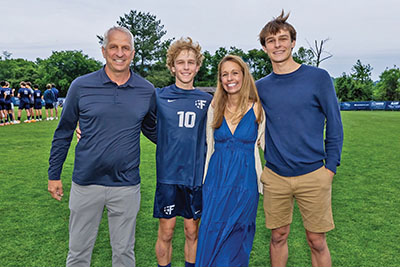
In the past five years, Sorochan — a University of Tennessee turfgrass professor — has led teams from UT and Michigan State University in a cutting-edge research collaboration with FIFA for the 2026 World Cup.
With a goal of safe, consistent fields across all 16 World Cup sites, Sorochan and his team have developed new technology, performed 170 tests and reshaped the way grass surfaces across the world will be evaluated from this point forward.
In the process, they built the fLEX device — a machine used to test different cleats on a natural pitch — and discovered the grass blend to use for different climates across World Cup venues: Bermuda grass for warmer venues, a blend of Kentucky bluegrass and ryegrass for cooler and indoor stadiums, and a blend of synthetic fibers stitched within each pitch to offer consistent bounce.
For Sorochan, the work paid off when he heard the word “immaculate” in a description of the grass during the United States’ opener with Paraguay.
“When you hear those things, it’s cool, but it’s not just me,” Sorochan reflected. “It’s all the moving parts and everything it takes to get that where it was: growing the sod in Washington state, going to visit the sod farm, talking with them and the stadiums and FIFA having that vision. It’s been really cool knowing what it took to get it where it’s at today.”
Yet none of the World Cup surfaces qualified as Sorochan’s favorite soccer pitch.
Instead, that honor belongs to the ones he designed for his sons, Charlie and Ian, at their Farragut home.
“It was on my 8th birthday when he first did it,” said Charlie Sorochan, who just wrapped up his senior year as an All-Region selection for the Farragut soccer team. “That week was super fun, and it looked professionally cut and painted.”
The field drew praise across social media; but because of his professional work, Sorochan was able to add an extra touch, too.
“They had their friends over and played, and I had just gotten back from a trip to Spain looking at golf courses and the pitch where Real Madrid plays,” he said. “We had flags from the pitch manager for the Columbus Crew, I brought back a red and yellow card from Spain, and they sent the spray foam to do the lines for penalty kicks. So when Charlie, Ian and their friends were playing, I thought it would be nice and controlled.
“Instead, they knew I had a red and yellow card and that foam, so they did nothing but try to foul one another so I could spray that foam in the yard.”
That is one of several happy memories for Sorochan, merging his career with a passion that dates to his own childhood in Canada.
Growing up, he dreamed of playing in the Canadian Football League or making bicycle kicks like Brazilian soccer star Pelé.
Now, he has developed the grass Pelé would play on if he suited up today.
“It’s the last thing I ever thought I’d be doing, leading research for the World Cup and living in Tennessee,” Sorochan said with a smile. “But I do remember watching the World Cup, and I’m a lifelong fan of the game and all sports. To have a way to stay in the game has been unbelievable.”
He has not only worked in soccer, having partnered with the National Football League, Major League Baseball and Major League Soccer, too.
When those games come on television, Sorochan scopes out the surface through the screen.
He has done the same through the World Cup, recording the games he can’t stay up for to ensure each surface is performing as designed.
“You can always see something,” Sorochan said. “When they’re passing the ball, they want the surface wet so the ball will skip and be faster for the play. They water just before the game and at halftime, and some teams even do it during these hydration breaks.
“When they switch fields and they kick the ball and it lands, how is it rolling? Then when players are cutting and moving and a player slips, what happened? A lot of times, it’s because they put their foot in an awkward position, but I don’t want the surface to be a contributor to them slipping.”
The stadiums are being tested regularly throughout the 48-team tournament, which runs through Sunday, July 19.
Until then, Sorochan is communicating constantly with the FIFA team in Miami, where a monitor displays a live feed of all 16 pitches across the world. He also receives photos from every pitch every day to determine the state of each one.
The process is a bit more in-depth than sons’ Farragut High School games — though Sorochan would look for any divots or stray sprinkler heads before kickoff there, too.
Once each game began, though, he would shift into dad mode.
“Watching my boys play, that’s the only time the field’s not something I’m thinking about,” Sorochan said. “Whether it was Charlie or Ian, everything disappeared from what I do as a career."
It has been that way throughout his life, putting family first and career second.
Ian Sorochan — now a rising senior at Tennessee — has even worked with the research team for a summer job while Charlie Sorochan has shared his dad’s work with friends at Farragut.
“I think it’s really awesome,” Charlie said. “When I was a kid and he was doing stuff for the NFL, I got my first taste of it. I thought that was cool, but this is a whole other level because of how much I like soccer and how popular it is.”
John and Ian watched Spain play in Atlanta last week, and the family is visiting Canada together for today’s meeting between Vancouver and Switzerland.
When they settle into a pub and go into the stadium, both aspects of John Sorochan’s life will be together in his home country.
But then again, they merged 11 summers ago in Farragut, too.
“It’s a dream come true, getting to have a hand in the World Cup, helping them select the grasses and construct the pitches for the stadium,” Sorochan said. “This has allowed me do something I love to do in my backyard — which is probably the most important pitch of all for my kids and their friends — versus one on the world’s stage.”