
Calm coach, big results
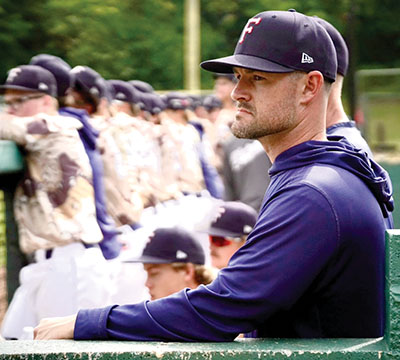
Eyebrows furrowed beneath his navy cap, left arm resting on the dark green concrete block, Copeland evaluates every second with the same even-keeled, tight-lipped expression.
The facial features give a glimpse into his mind, which spins with sound evaluation at every turn.
“I’ve kind of been that way my whole life,” he confessed at a recent summer camp. “I’m not really a highly emotional guy on the outside. I like to think through things and be logical about it.
“My grandfather was always that way, and it’s something I always respected about him. This is the situation, this is what’s at hand, and emotion isn’t going to change it. This game needs level-headedness, so I feel like that’s the best way to approach things.”
So far, the method appears effective. A couple weeks before he offered that statement, Copeland’s Farragut team won its TSSAA-record fifth straight title.
In the process, he joined an elite set of predecessors — Matt Buckner and Tommy Pharr — who also guided Farragut teams to their ultimate goals.
When asked about that honor, Copeland referred to himself as a figurehead — citing the community support, player and parent commitment and involvement from assistant coaches Bill Mink, Daniel Sharp and Dave Roberts.
But he, too, has played a role, using the same baseball mind that developed just a few miles down the road.
Bearden bred
Matt Buckner has seen both sides of Garrett Copeland.
He had plenty of opportunities, watching Copeland mature into a steady left-handed pitcher for the Bulldogs in the late 2000’s.
Even then, the signs were visible of the career to come.
“He was a really good player, but he’s always had a really calm demeanor and has thought about things in a good way,” Buckner said. “He’s got a good disposition for coaching, but don’t let that fool you. He’s a fiery dude.”
That flame — and talent — proved enough to fuel Copeland on to Lincoln Memorial University.
But when an injury brought his career to an abrupt halt, he took a year off from the game and transferred to Tennessee to finish out his undergraduate work.
Little did Copeland know how his return would shape his future.
From flaws to Farragut
When Copeland decided to step back into baseball, he took on a far different role than the one he’d left a few years prior.
Rather than playing, or even coaching, he strapped on shoulder pads, tugged on a mask and, for just one season, stepped behind the plate as an umpire for the TSSAA.
“As I was umpiring, I noticed a lot of flaws in high school baseball,” he said, “and how things were run and how kids were doing it — so I decided I’d like to get into coaching just to help. Really, that was the start.”
A conversation with Buckner followed, as Copeland brought it up the next time he worked a game at Farragut.
“He said to come out the next year, and the rest is history,” Copeland cracked. “I’ve been here ever since.”
Since his senior year in college, Copeland’s status within the Farragut program has certainly changed.
He coached third base for a while then called pitches under Buckner.
As his role changed on the field, it changed in life, too, with marriage to his wife Ashley and becoming a father to their daughter, Hadley.
Through it all, Copeland took bits and pieces from the man he had looked up to since high school.
And on the baseball side, he learned how to run a program that produced five state titles during his time as an assistant.
“Honestly, he was a little more fiery when I played for him than at the end of his career,” Copeland said of
Buckner. “He evolved with the game, and he was a really
good players’ coach. As I matured and became an adult, seeing how he interacted with the players and looked after them, he did a good job in that.”
Along the way, Copeland found the right balance between passion and poise.
So by the time he was tabbed as Buckner’s replacement in 2024, Copeland brought plenty to his new perch in the dugout.
“You have to support your players, and there’s a time to be fiery,” Copeland said, “but there’s also a time to teach and coach and get better. You can’t berate a kid because you never know what’ll happen. He could be a huge part of the win. But if you shut him down, you’ve lost that chance. It’s situational, though, and the game will dictate what it needs to be.”
In both roles, Copeland has learned the hard truth that comes with coaching — the lack of control — and tries to prepare ahead of time with an emphasis on fundamentals.
Now, that focus has yielded the same result as Buckner and Pharr.
And if Copeland’s cool leadership has been any indication, the success should only continue.
“It’s a really special place when it comes to baseball, and it’s a special culture of winning and working,” Buckner said. “That only happens with good leadership, and obviously he’s taken that and able to do the same thing. It doesn’t just happen by chance, I promise you. There’s a lot that goes into it.”