
Revolutionary War veterans helped build Farragut
Anyone driving along Concord Road will see Pleasant Forest Cemetery, which was established in 1796, and has interred there three American Revolutionary War soldiers: Thomas Boyd; David Campbell, who started the first settlement in what now is known as Farragut; and Archibald Roane, the state’s second governor. Malcolm Shell, a Farragut historian and Farragut Museum supporter, has shared some of the Town’s past, its other prominent people, such as Adm. David Glasgow Farragut, and sites.
One of the earliest people known was David Campbell, who arrived around
noon, March 7, 1787, according to Shell.
“He was from Augusta, County, Virginia,” Shell said of Campbell. “He first went to Strawberry Plains and a later date moved to Knoxville and from Knoxville to here.
In the Revolutionary War, “[Campbell] served with George Washington at the Battle of Long Island Flats,” the historian said. “He held the rank of captain.
“He arrived here with a man named Archibald McCaleb, just their two families,” Shell recounted. “When they got here, the first thing they did was build lean-tos [makeshift shelters] for their families.
“In a few weeks, they were able to build cabins for the two families,” he said.
Then as families would arrive, “they would stop their work and build cabins for them,” Shell said. “They were located at the intersection of Campbell Station Road and Kingston Pike, right there with Rick Terry [Jewelry Designs is now] on one side and Starbucks on the other — just right in the middle of the intersection.”
“That was in 1787,” he noted. However, shortly after living there, “they built a stockade fence around it to protect themselves from Native Americans.
“McCaleb was one of the first volunteers,” Shell said. “He served with Andrew Jackson at the Battle of New Orleans [in the War of 1812). After the battle, he came back to Campbell’s Station. He was killed a short time later on Sinking Creek by a roving Native American band. His body was found later.
“There are some who believe he’s buried in Virtue Cemetery,” the historian said. “We don’t know.”
David Campbell donated the property for [Pleasant Forest] Cemetery,” cemetery director David Stinton said.
“[Campbell] started a meeting house there,” Shell said. “It was OK until the Civil War. It was originally a wood structure then it became a brick structure.
“It was disassembled during the [Civil War] to provide bricks for the chimneys, where the Union Army cooked,” he added. “The army wintered there in the winter of 1863.”
Another soldier, Boyd was a captain under Washington, Shell said. “The Boyd community is now named after him. He’s buried in Pleasant Forest Cemetery.
“He was, likewise, a community leader at that time,” the historian said.
Roane, who became the state’s second governor and resided at what is now Admiral Road, had his own place in history.
According to Wikipedia, Roane, who served from 1801 to 1803, won the office after constitutional restrictions prevented John Sevier, the first governor, from seeking a fourth term. He was tangled up in the rivalry between Sevier and Andrew Jackson.
When the Tennessee state militia convened to elect a commander, the vote was a 17-17 tie between Jackson and Sevier. Roane selected Jackson, fueling animosity and 1803 duel between the two men, at which the men separated without a single shot being fired.
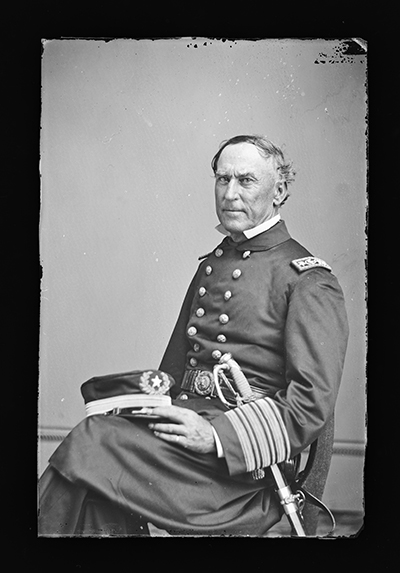
Another prominent figure related to the Town is David Glasgow Farragut, whose father Jorge Farragut, also a Revolutionary War soldier, settled in old Concord, what was then Lowe’s Ferry. David was born July 5, 1801, to Jorge and Elizabeth Farragut at Lowe’s Ferry on the Tennessee River. After Elizabeth died, the Town’s records showed Jorge gave his son, James Glasgow Farragut, to David Porter, a commodore in the U.S. Navy, to rear. Porter, in turn, enlisted James, who later changed his name to David in honor of Porter, as a midshipman in the Navy. He would rise to the ranks of admiral and would lead men in the Battle of Mobile during the Civil War.
Other history in the area:
• The Village of Concord was founded and platted in 1854 in response to the establishment of the railroad and marble industry, according to Town records. “In 1852, the East Tennessee and Georgia Railroad, later to become the Southern Railway, purchased the right-of-way in the Big Sinking Creek area,” the reports stated. “In 1853, construction along the north bank of the Tennessee River caused a population and development shift to the area that later became Concord.”
• Battle of Campbell Station: Nov. 16, 1863, the clash occurred between the troops of Lt. Gen. James Longstreet, who had two divisions, about 5,000 cavalry and about 12,000 troops detached from the Confederate Army of Tennessee near Chattanooga and Maj. Gen. Ambrose E Burnside’s Union Department of the Ohio troops.
The battle began on a cold, miserable day with the Union forces arriving first at the intersection of Concord Road and Kingston Pike, the town records reported. After six hours of heavy fighting, the Confederates failed to break through the Union line. Total casualties were 348 Confederate and 338 Union troops.