
The road ahead
TDOT outlines options to address needs along I-40/75
-
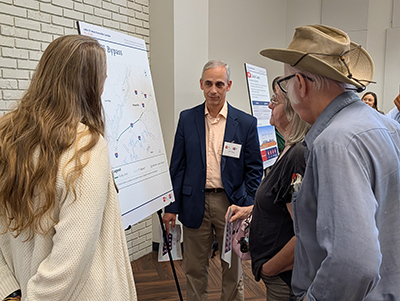
Jeff Mize, vice president and senior roadway design engineer for CDM Smith firm, explains TDOT’s proposed improvements plans to residents during at public meeting in Farragut Community Center Wednesday evening, July 1. - Tammy Cheek
-
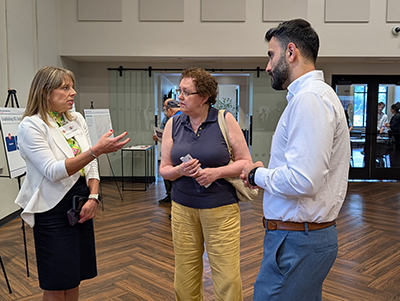
Deanna Lambert, left, and Akar Aran, consultants for Tennessee Department of Transportation talk with citizen Laura Hoffman about TDOT’s proposed improvements during at public meeting in Farragut Community Center Wednesday evening, July 1. - Tammy Cheek
More than 100 residents attended a Tennessee Department of Transportation public meeting at the Farragut Community Center on Wednesday, July 1, to review proposed improvements to a 17-mile stretch of Interstate 40/75 aimed at easing congestion, improving safety and upgrading aging infrastructure.
The meeting focused on TDOT's Planning and Environment Linkages (PEL) study for the interstate corridor from the I-40/I-75 interchange in Loudon County to the I-640 interchange west of Knoxville.
According to TDOT, eight alternatives have been developed to address growing traffic volumes, truck traffic, aging infrastructure, drainage issues and safety concerns. Two of those alternatives — adding general-purpose lanes or constructing choice lanes — are the preliminary recommendations while six others remain under evaluation.
"Right now, we've got eight alternatives that have been researched," TDOT Regional Communications officer Mark Nagi said. "Two of those are the preliminarily recommended alternatives: choice lanes and general-purpose lanes.
"The other six are still being evaluated," he added. "So, the study will continue, and we expect to have this study complete by the end of the calendar year. At that time, there will be multiple alternatives that will go forward into the engineering phase, the NEPA environmental phase.
"After that, we will see where things stand and if we can get this implemented in TDOT's 10-year plan," Nagi said.
Residents filled the community center's Assembly Hall
to examine display boards
outlining the alternatives while speaking one-on-one with TDOT staff members and consultants.
"It's my understanding that this is just the beginning of the process," said Steve Krempasky, former Shop Farragut/Farragut Business Alliance executive director. "They have until 2030 to put together the total plan for this bypass, which is desperately needed because so much through traffic just clogs the town's arteries and doesn't stop."
Krempasky also praised TDOT's approach to gathering public input.
"You can see TDOT is working hard here," he said. "They've got so many representatives out on the floor talking one-on-one with people. I thought that was kind of cool, and there are opportunities to comment on paper and online."
"There's a lot of public involvement, and that's important," former Farragut Municipal Planning Commissioner Ed St. Clair said. "Somewhere in these alternatives a solution will emerge, but the problem needs to be solved. It needed to be solved like 30 years ago."
State Sen. Becky Massey said improving the interstate corridor remains one of
Tennessee's top infrastructure priorities.
"I was pleased with the turnout at TDOT's public meetings regarding possible solutions to our increasing congestion on I-40/I-75 through Knox County," said Massey, who represents District 6. "I'm thankful for the major investments the Tennessee General Assembly has made during the last several years, but we're going to have to do a lot more to meet the infrastructure needs of our state.
"I will continue to advocate for long-term solutions to meet the challenges of a growing population, increased costs
of building and maintaining our roads and the increased wear and tear on our roads," she said.
State Sen. Dr. Richard Briggs, who represents District 7, said TDOT presented a thorough overview of the project.
"I believe that TDOT presented all the different options, how they arrived at them and what their decisions are," Briggs said. "They had many of their engineers and out-of-town consultants there to answer anyone's questions around the posters."
Briggs said the project will likely come down to either adding one lane in each direction or constructing choice lanes.
"But there are too many things that have to be decided," he said. "One is what the final plan will be. I believe it's really going to come down to whether we add one additional lane in each direction or build these choice lanes, which would be pay lanes with two additional lanes in each direction."
Funding, he added, may be the larger challenge.
"Probably a bigger issue is how we're going to pay for this," Briggs said. "That's also going to determine how long it takes."
Briggs, who serves on the Tennessee Advisory Commission on Intergovernmental Relations, said the committee has been studying transportation funding options.
"They've gone through a
92-page report on different ways we can pay for
this," he said. "They give three different scenarios.
"However, we're a pay-as-you-go state," Briggs added. "The only source of revenue to maintain and build roads is the gas tax. We're going to have to come up with a different way to pay for it."
Farragut Mayor Ron Williams said the study also addresses another longstanding concern: flooding along the interstate corridor.
"All along the ridgeline, you've got flooding of water that comes in, and it's all headed to the lake," Williams said. "We call this area Turkey Creek. You've also got Second Creek and Third Creek in the City of Knoxville. All that water has to go somewhere."