
Camino Journal: Part 6
Reaching the ‘end of the world’
The final three or four days leading into Santiago had been crowded with pilgrims from all over the world. It is the most popular section of the Camino because pilgrims who want to officially complete the journey and receive the Compostela, the official certificate of completion, must walk at least 100 kilometers, or 62 miles, into Santiago. At the beginning of the journey, every pilgrim receives a credencial, or pilgrim’s passport. Along the way, we were required to collect at least two daily stamps, known as sellos, from churches, cafés, hostels, town halls and other places along the route.
Our pilgrim’s passport never left our side. We guarded it as if it were a million-dollar bill. But to us, it was worth far more than that. Every stamp represented another day, another village and another step forward. It represented our journey — the highs, the lows, the challenges, the friendships and the memories we would carry home with us.
When the four of us left the iconic city of Santiago early the next morning, we were energized and excited. The Atlantic Ocean was calling. Thirty-four days earlier, the coast had seemed impossibly far away. We had already walked approximately 485 miles, yet our ultimate destination was still ahead of us. For the first time, Finisterre felt within reach. But the Camino wasn’t finished testing us. The next three days would bring steep climbs and long, rocky descents. After more than 30 days of walking, we knew plenty could still go wrong — blisters, injuries, illness or simply exhaustion. But through it all, we felt that the Lord had protected us. Our Camino family kept moving forward, one step at a time, strong and together.
And this time, the Camino was much quieter. Most pilgrims finish their journey in Santiago, so once we left the city, the crowds disappeared. There were far fewer people on the trail, and we were perfectly fine with that. Our Camino family was still together, and we were determined to reach the coast as one.
One thing we quickly learned about the Camino is it is almost impossible to get lost. Bright yellow arrows painted on trees, buildings, sidewalks and telephone poles guide pilgrims along the route. The scallop shell, the iconic symbol of the Camino, also appears everywhere — on stone markers, metal plaques and ceramic tiles. And then there are the distance markers. Throughout our journey, we had watched the numbers steadily decrease. On day one at Saint-Jean-Pied-de-Port,
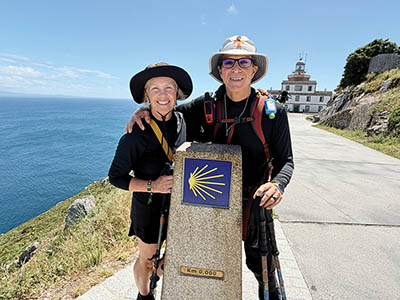
we stood beside the marker showing 778 kilometers to Santiago. Now, we were determined to stand beside the marker at Finisterre showing 0.0 kilometers.
The days were long, but they were incredibly rewarding. I found myself becoming increasingly proud of our Camino family and especially of my wife of 37 years, Nancy. Walking the entire Camino Francés had been on my bucket list for years. When I asked Nancy if she would take on the challenge with me, she never hesitated. Not only did she say yes, she became the spiritual backbone of our Camino family. Her contagious smile, positive spirit and willingness to help anyone who needed it made her an inspiration to all of us.
Then came our final day, and it would become our longest day on the entire Camino, 25 miles. The excitement was overwhelming, but there was also a sadness we couldn’t ignore. We knew that reaching Finisterre meant our 37-day Camino family would soon have to go its separate ways. We had spent more than a month walking together, eating together, laughing together and sharing our lives with one another. Soon, it would be over.
We had been walking for hours through a beautiful wooded trail when, suddenly, all four of us stopped. We couldn’t believe what we were seeing. The Atlantic Ocean! After hundreds of miles, countless hills, sore feet, blisters, rain, heat, laughter and more memories than we could count, there it was: the Atlantic Ocean. We stood there speechless, simply staring at it.
We eventually made our way down the mountain and found the first place where we could take off our shoes and socks and walk into the water. And there we were, standing in the Atlantic Ocean. After dreaming for years of completing this journey, it was finally real.
We had walked approximately 22 miles that day, leaving only 3 miles to go to reach the lighthouse and the elusive 0.0-kilometer marker. Then, in true Camino fashion, something completely unexpected happened. As we were nearing the lighthouse, a man walking past us noticed the orange Power T on my bucket hat. He yelled, “Go Vols!” Of course, we stopped and we asked where he was from. He told us he was from a small town in Tennessee called Farragut, and that he lived in a subdivision called Village Green. We couldn’t believe it. We had walked nearly 600 miles across Spain, all the way from France to what was once considered the end of the world, only to run into a stranger who lived just a few miles from us back home. Talk about a small world!
We continued toward the lighthouse. Just as we had done three days earlier when we arrived in Santiago, the four of us locked arms. Together, we walked the final 100 feet toward the 0.0-kilometer marker. After 584 miles and 1,433,588 steps, we had finally reached the end. There was nowhere farther west for us to walk. We had done it. We had walked from Saint-Jean-Pied-de-Port in France, across northern Spain, through the Pyrenees, across the Meseta, over the Cruz de Ferro, into Santiago de Compostela and finally all the way to Finisterre, the end of the world!
It was an incredible feeling but it was also bittersweet. Our 37-day Camino family had become something far more meaningful than four people simply walking the same trail. We had become family. And now we knew we would soon have to go our separate ways. Perhaps we would never see each other again, or would we?
And that is a story for another day. Until then, my friends, Buen Camino!