Nature photographer shares with Rotary Club
-
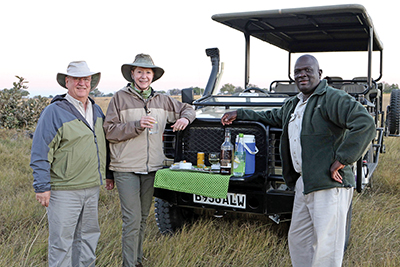
Steve Brandon, left, and wife Patsy and gold level guide, “Mr. Bee,” Bonnetswe Sarafo, relax outside of their jeep during a safari in the savanna. - Photo submitted
-
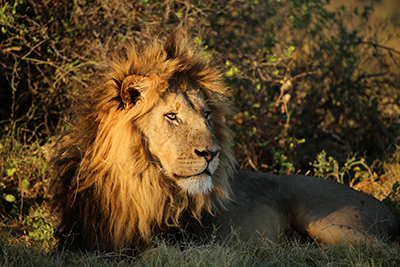
While they are called king of the jungle, lions make their home in the savannah in Botswana. - Photo submitted
Lions and leopards and crocodiles … oh my!
Nature photographer Steve Brandon of Chattanooga shared images of the swamp lions of Botswana with Rotary Club of Farragut members during their meeting in Fox Den Country Club Wednesday, Sept. 30.
“They call him the king of the jungle, but he’s not in the jungle,” he observed. “He’s in the savannah.”
Brandon “has photographed wildlife in all seven continents and has spoken to more than 125 nature groups, civic clubs and schools about wildlife and conservation,” president-elect John Rock said. “Steve and his wife, Patsy Fowlkes, are both Rotary Paul Harris Fellows.”
Brandon spoke to the club last year about a trip to Tanzania in Kenya to see the Great Migration.
In Botswana, Brandon got up close and personal with the lions to photograph the creatures.
“The thing, to me, is the eyes,” he said. “If you look at every one of these photographs, … those golden eyes.
“Actually, they’re pretty hard to see,” Brandon said about the lions, who use the savannah grasses as cover. He indicated one photograph and said, “There’s a great back story of him sneaking up on me.
“We were out of the truck and the ranger told us to get back in the truck fairly quickly, so we did,” Brandon recalled.
“Botswana is almost exactly the same size as Texas,” he said. “It’s a five-hour flight from [Lake Victoria] to Botswana.”
In 1855, it became a protectorate,” Brandon said. “In ’66, it got some independence, very stable democracy, great economy. Tourism is 22 percent of the entire economy, and all they have for tourism is us coming to take pictures — no hunting in Botswana, except for very limited areas.
“You may have heard of the Kalahari Desert,” he said. “It’s right in central Botswana. You may heard Chobe [National] Park. It’s up in the northeast corner.”
Brandon was at the Okavango Delta or Grassland, a vast inland delta formed where the Okavango River reaches a tectonic trough, in the upper northwest.
“It’s the world’s largest inland delta,” he said. “It’s one and a half times our Yellowstone [National Park]. It does not flow into a river or ocean. It is an inland delta. The average rainfall is only 18 inches. Here, it’s about 60.
Still, “You’re going to see pictures of water everywhere,” Brandon said about the delta.
While in the delta, he photographed the lions, as well as leopards, cheetahs and wild dogs, as they stalked their prey: Cape buffalo, antelope, impalas, springbok, tsessebe and red lechwe.
After World War II, Brandon said the British were starving, didn’t have enough food, so they decided to take Botswana and raise cattle.
Along with predators, they were concerned about the Cape buffalo infecting the cattle with diseases, so they built a 400-mile-long electrified fence.
There is agriculture on the east side of the fence and the Okavango Delta on the west side.
“They have no paved roads allowed; they have no cross country electric allowed; they have no permanent buildings allowed,” Brandon said. “They have no [other] fencing allowed. [The delta] is just as it has been for a thousand years.”