
Retired admiral recalls ‘rewarding’ experience
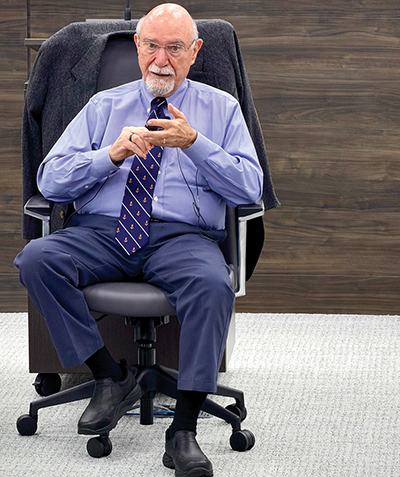
Sporting a navy tie with anchors on the front, the retired admiral folded his
hands together and regaled audience members with various tales from his 35-year career in the U.S. Navy on Veteran’s Day as part of the Farragut Museum’s monthly History Hour.
“Obviously today is Veteran’s Day, so it’s a day to honor all veterans,” Farragut Museum historic resources coordinator Kristi Vining said Wednesday, Nov. 11. “But obviously in Farragut, we are especially proud of admirals, being named for Adm. David Farragut. So we made a connection earlier in the year, and I reached out and asked if he would speak today.”
After a lifetime of experience, the 83-year-old was all too happy to share his journey.
From the Pearl Harbor shipyard to Washington D.C., Vietnam, Australia and even the bottom of the ocean in a submarine, Felton’s work took him across the globe.
As he rose through the ranks, Felton designed and maintained ships at shipyards throughout the country.
“All services are broken into two groups: the operational commands and the ones who train, equip, provide and give operators what they need,” Felton said. “I was one of the train, equip and provide guys.”
One stop in his career included the Portsmouth Naval Shipyard in Kittery, Maine, where Felton oversaw projects involving as many as seven nuclear submarine overhauls.
Coincidentally, during his time in Maine, Felton lived in the same building where Adm. David Farragut died in 1870.
And with Farragut’s statue standing watch just outside the room where he spoke, Felton addressed a journey that took him even further in knowledge than it did in miles.
After beginning his education in a two-room schoolhouse in Kansas, Felton earned a Bachelor’s of Science degree in aerospace engineering. That background and his military service advanced Felton to the pinnacle of his career, which included postgraduate education at the Massachusetts Institute of Technology (MIT).
“Really eye-opening for me as a farm kid,” Felton said with a smile. “I started in a two-room school house in the eighth grade in the Ozark hills. It’s the best thing, probably, to ever happen to me.”
But Felton offered a similar sentiment on his wife, Linda, whom he married just four days after he was commissioned.
“And then,” he said, “we were off to the races.”
Together, the couple traveled wherever Felton’s assignments took them — though there were days when “she wouldn’t even know where in the world I was,” he said.
Felton worked on an aircraft carrier right before the Vietnam War, happily taking an assignment as a mine-sweeper rather than flying jets in war-fighting.
“We swept a couple things,” he said, “that would rattle your teeth when they went off.”
Felton found similar thrills in jobs on the U.S.S. John R. Perry, where Felton and his shipmates “had to be ready to go anywhere in the world” on 72 hours’ notice.
And while he could not divulge everything about what all he did within each job, Felton did say one thing: “It was exciting.”
On board the U.S.S. Gray, a 1,200-pound destroyer, Felton found “another great assignment,” he said. “I would take new crew members back to one of the boilers where we’d have the 750-degree steam and lay a sheet of paper on that valve and it would catch fire.”
Yet even with everything he enjoyed throughout his career, Felton and the men he worked alongside felt the familiar tug of home, too.
“We got mail from aircraft flying over, dropping drums that contained letters from family and baked goods,” he said. “One that was highly-anticipated were rum-filled chocolate brownies. So we always looked for the drop.”
In 1996, after 35 years of service, Felton retired from the Navy and worked at Y-12 in Oak Ridge. Later, he even served as the vice president at Lockheed Martin.
In total, Felton experienced such a full career he admitted to forgetting some aspects as he put together his Veteran’s Day speech. But the journey and its lessons remain as close as the navy tie he wore to commemorate the occasion.
“Military service really defines you, and not only me, but the family, too,” Felton said. “My wife and I, we did this as a partnership for all that period of time and it defined the two of us. And I’d go do it again. I can’t think of much of anything I would change, and it was enormously rewarding.”